
In many Christian churches and places of worship, the center of worship is a simple, empty cross.
The difference is the Crucifix, a staple in Catholic, Eastern Orthodox, and many Anglican or Lutheran settings.
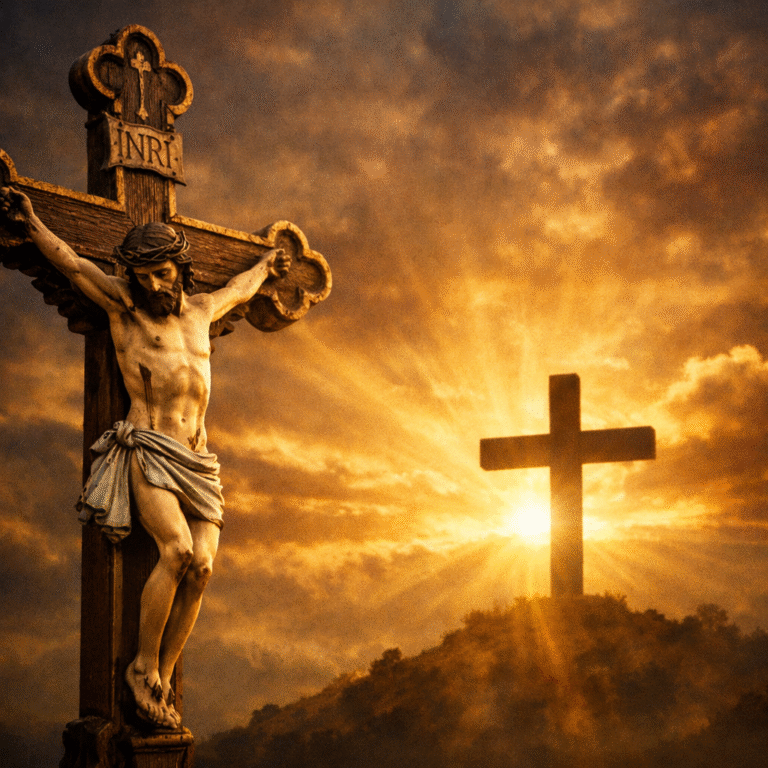
The Cross in these churches features the Corpus Christi, the body of the crucified Christ, thus called a Crucifix.
The commonality is the power of Christ—understanding the Catholic Crucifix and the Cross.
The Price of Redemption
The image or the structure of the Crucifix features the Corpus Christi (in Latin, used in Catholicism primarily to mean the body of the crucified Christ).
For Catholics, this Crucifix with the body of Christ serves as a profound theological statement rather than a mere decorative choice, the price of redemption.
Catholics venerate the Crucifix.
In reply to those who accuse Catholics of idol worship when praying before the Crucifix, the Catechism of the Catholic Church distinguishes between veneration (respect) and adoration (worship), holding that a Crucifix is a visual representation of Christ’s sacrifice, not an idol.
“Based on CCC 2112–2114, idolatry occurs when a person honors and reveres a creature in place of God, effectively transferring to it the worship due to Him alone.”
The Crucifix is a tool for focusing prayer, not God itself.
Also, the primary reason for the use of the Crucifix is to provide a visual reminder of the historical reality of the Crucifixion.
The Crucifix reflects that salvation for sinful humanity was not a symbolic gesture; it was “purchased by real suffering, real blood, and real sacrifice.”
All borne by the only begotten “Son of God” in Jesus Christ.
By displaying the body of Jesus, the Crucifix implies the costly nature of redemption and the depth of Jesus’ love taken to its extreme.
The empty Cross, on the other hand, is a powerful symbol of victory and the resurrected Christ.
The Crucifix explains exactly how that victory was won: through the body and blood (sacrifice) of Christ.
“There is our Lord wounded and suffering His passion as He dies on the Cross, as a sacrificial lamb in atonement for our sins.”
The Inseparability of Good Friday and Easter
The Power of Christ: Understanding the Catholic crucifix and the cross becomes more significant when we view the two events of Good Friday and Easter together.
The Resurrection of our Lord is the core of our faith in Christianity.
Without Resurrection there would be no truth in the faith.
Resurrection proves that we worship a living God.
Regarding the Crucifix, a few express that it dwells too much on suffering, arguing that the glory of the Resurrection should be the focal point.
This, as per Catholic theology, is a misunderstanding, and they view that the Resurrection cannot be separated from the Passion: one cannot truly understand the joy of Easter Sunday (Resurrection) without first passing through the sorrow of Good Friday.
“The suffering of the Lord was because of our transgressions and sins.”
But he was pierced for our transgressions, he was crushed for our iniquities; the punishment that brought us peace was on him, and by his wounds we are healed. (Isaiah 53:5)
For the Catholics, the Crucifix plays a vital role during the Holy Eucharist (Mass).
The Catholics believe the Mass is the “unbloody re-presentation of the Calvary.”
The sight of the Crucifix near the altar provides a visual proclamation of the sacramental reality occurring during the Eucharist.
Christ’s supreme once-for-all sacrifice is made perfect again for the faithful at the Eucharist.
For Catholics, the sight of our Lord Jesus on the Cross should be a reminder that our salvation was bought by Jesus’ sacrifice.
The Crucifix and the Empty Cross are not Contradictory
Many Protestant reformers moved toward the empty Cross to emphasize the “finished work” of Christ and His current state as the risen Lord.
But not to take away, they equally revere the passion and sacrifice of Christ as they pray to the Cross, symbol of Christ and all His redemption and sacrificial love.
For Catholics, however, the crucifix remained a tool for “redemptive suffering,” the spiritual practice of “offering up” one’s daily pains and joining them to the sufferings of Christ, as seen in the crucified Christ on the Cross.
Crucifixes and empty crosses act as complementary symbols that highlight different facets of the Christian salvation story, ranging from the price of redemption to the triumph of the Resurrection, working in unison.
The Role of the Empty Cross
The empty Cross is primarily used to proclaim victory and emphasize the Resurrection, Jesus’ victory over death.
It serves as a powerful symbol of the finished work of Christ and the hope that follows His death—thus, a resurrection for us too, as promised by the Lord.
In this context, it represents the result of the salvation story: the triumph over death and life in eternity.
The Role of the Crucifix
The Crucifix featuring the corpus (the body of Christ) focuses on the “costly” nature of redemption.
It is the story of just how the “victory was won.”
The Catholic Crucifix and the Cross are not symbols in competition or conflict; both are necessary to understand the faith fully.
The Crucifix emphasizes what Jesus did for us, humanity—His suffering and sacrifice.
While the Cross emphasizes what followed—His victory and resurrection.
Together, they tell the story of salvation.
One calls us to remember His love; the other calls us to rejoice in His triumph over death and now eternity.
Both the Catholic Crucifix and the Cross lead believers closer to Christ, deepening faith, gratitude, and devotion.
What Does Crucifix and Cross Mean To Every Believer in Christ
The Power of Christ—Understanding the Catholic crucifix and the Cross builds faith and hope, nurturing various spiritual needs in a believer’s journey.
The Crucifix speaks deeply to moments of suffering, guilt, or repentance.
A Christian can feel related to Jesus through shared suffering, as He also suffered in the flesh.
When believers face pain or feel burdened by sin, seeing Christ on the Cross reminds them that He understands suffering, pain, loneliness, stress, and betrayal, as He has faced them all.
A believer can bring all their sins to Jesus, knowing He has borne them all out of love.
The Crucifix becomes a source of peace, comfort, humility, and sincere repentance.
The Cross is a source of hope and upliftment of heart during times of doubt or discouragement. It proclaims that suffering is not the end.
There is a light after the deep darkness.
It points to the risen Lord, assuring believers that victory, healing, and new life are possible through Christ.
Thus, the Crucifix draws the believers into reflection, while the Cross lifts them into hope.
One grounds faith in the reality of sacrifice; the other strengthens faith in the power of resurrection.
The power of Christ is centered at the Catholic Crucifix and the Cross, rather than dividing the Christians, and reveals the fullness of Christ’s mission, from sacrifice to victory.
It teaches us that Christianity is not about the Cross we carry in our daily lives, but also about the glory that awaits us.
Together, both the Catholic Crucifix and the Cross enrich worship, deepen understanding, and unite believers in the same saving truth of Jesus Christ.
“In our daily lives, we are called to both carry our Cross and live in the joy of the Resurrection.”